Showing posts with label meditation. Show all posts

Sunday, February 5, 2017

Meditation To Cleanse The Mind

In my earlier posts, I have given an introduction to the Rudram and an introduction to the concept of Ishwara. 

The Veda gives us five different types of Yagnas to connect with Ishwara; 
  1. Manushya Yagna : Loving and supporting other human beings
  2. BhutaYagna: Supporting the nature and other living beings 
  3. Pitru Yagna : a. Love and support for family Pitru Yagna  b. Remembering and being grateful to ancestors
  4. DevaYagna : a. Surrendering to GOD / Higher Cause b. Propitiating our own body and mind c. Prayers and all spiritual / religious practices
  5. BhrahmaYagna: Study and propagation of the scriptures
Shri Rudram can be used as a means for performing Deva Yagna and BhrahmaYagna. 

Imagine we are going on a road trip from the East coast of USA to the West coast. One of the key things we would do is to ensure that the engine is working well and the fuel/oil is clean. In the same way, before starting on the study of the Rudram as a Yagna to connect with Ishwara, it is essential to clear our mind of impurities. If we look at our basic structure, we have a gross physical body, a mind, a intellect and the driving chaitanya or soul. Let us focus on the mind. 

The mind is a seat of emotions. Its very nature is that it is wavering. If I were to tell you right now, not to think of a monkey sitting on a tree, your mind surely is thinking of it. It is something that is seemingly not in our control and accumulates various emotions like jealousy, anger, greed, love, etc. These are what are the impurities of the mind. They are called impurities because they cause turbulence in the mind and prevent it from focusing. Hence if we are beginning the Rudra Yagna, our mind has to be purified to ensure we can focus on the Rudram. The preparation before embarking on the Rudram is known as nyasam.

Basically, as a preparation, we are doing the invocation of the deity in our body. When we worship we should also be as pure as the Lord . We purify the body by invoking various deities at various parts of the body. Nyasas include:

▪ Mahaanyasah – Larger invocation 
▪ Laghunyasam – Lighter invocation 

There is a meditation verse even for Naysam, which is the Dhyana shloka. Meditation is to be done to realize the essential unity of myself with the Supreme. One is advised to seek out a calm lonely place and select a fixed time every day to do meditation. There are several techniques suggested for meditation. Some of them are as follows:

a.Taking an image of a favorite God or angel or spiritual teacher and try to focus thoughts on that
b. Focusing on one's own shadow in the mind
c. Focusing on one 's own image as though in a movie
d. Focusing on a word or "shloka"
e. Focusing on one's own heartbeat
f. Focusing on one's own breath

There is no single technique that can be good for everyone. Readers are encouraged to try any of these and see what works best for them. During initial phase of meditation, it is almost impossible to focus the mind. The nature of the mind is to wander and create thoughts. So a practitioner can become disillusioned about the absolute lack of progress.  But this is very normal. The best strategy is to let the mind wander, but try to be aware that the mind is wandering and slowly bring the mind back to focus. The strategy is to be aware of such thoughts as they arise and observe them as they pass through the self. The idea is to be non-judgmental and just observe the thought as a third person.


The Dhayana Slokas of Rudram describe Lord Shiva in three different ways: 

  1. Lord as a person ; with hands & legs, ornaments, weapons, vehicle etc. (Eka roopa) 
  2. Lord as total creation endowed with all the forms of creation (Viswa roopa) 
  3. Lord as formless, attributeless; the Absolute Reality (Aroopa)

For a beginner in meditation, when it is difficult to control the mind, there is the need for a hook to attach the mind to. This could be any thing that a practioner wants to focus on. It could be  light source, an image etc. Here, the Dhyana shloka describes Shiva as a person and provides the ability to visualize Lord Shiva in a human form and meditate on that image. If we ask the purpose of this, the idea is that in focusing the mind on the image, other impure thoughts will not enter the mind. There is a detailed description of the physical form in the Dhyana shloka, which I will not be covering. Just as an example, the Lord is looked upon as an individual as pure as as a crystal. He has three eyes with the third eye representing knowledge. He has five heads which symbolize the following: 

1. Sadyojāta –Will power, Creative force associated with manipooraka chakra 
2. Vamadeva – Shakthi & beauty, associated with Anahat chakra 
3. Aghora – Power of knowledge, Svadishthana chakra 
4. Tatpurusha –Absolute Reality, MuladharaChakra, 
5. Ishana – Individual consciousness, Vishuddha chakra

My humble suggestion to readers is that at this stage of mediation, they should not try to focus on the symbolism, but just the image. 

Over a period of time, with regular practice, when the mind is fairly under control, it is worthwhile to step up to meditate on Ishwara  as total creation endowed with all the forms of creation (Viswa roopa).  In this form, Ishwara is  Eternal, which implies a concept beyond Time & Space. He is Changeless which implies that Changes with respect to time is zero. He is Pure. There is no movement, no distraction and no decay. In the next stage of meditation, the Lord is seen as  formless, attribute less and as the Absolute Reality (Aroopa). The entire universe is nothing but a manifestation of the Lord . HE is the form of whole universe and pervades the whole universe. 

Conclusion 

Before starting on the actual Rudram, the reader is advised to cleanse his mind through meditating on the concept of Ishwara in 3 different planes. Meditation prepares the mind for the journey of the Rudram study by:

1. A sense of discipline: Just as a regular physical exercise is a discipline that keeps the body fit in the long run, meditating regularly is a discipline that enables one to keep the mind fit for the long run.
2. A sense of calmness : All the while we are focusing our mind outwards and getting frustrated in the illusory world.Meditation turns the mind inwards generating a sense of calm.
3. A sense of positiveness : During meditation,if thought is of all positive things coming in as I inhale and all negative things going out as I exhale, there is a feeling of positiveness

Saturday, June 27, 2015

The Process Of Meditation

In an earlier article, I had introduced readers to the concepts of meditation. In this article, I will go a step further and discuss the meditation process. Please note that as meditation progresses, there is a need for a very specialized knowledge which we will discuss when I come to that stage of meditation. Broadly meditation consists of the following stages:

A: Develop a routine

Meditation needs dedication, a commitment and a willingness to put in effort even if results are not apparent at all.

It is absolutely imperative to develop a fixed schedule and stick to it. This is similar to any other human effort. If I want to get fit, I need to stick to a routine of regular exercises. If I have to reduce weight, I have to stick to a routine of exercises and diet control. Similarly, for meditation, it is absolutely essential to have a routine.

The suggestion is to select a quiet place away from regular activities. Over a period of time, that place should automatically be associated in the mind as a place for meditation. We go into the kitchen and the mind is associated with eating. We go to the bed room and mind associates with sleeping. Similarly, it is necessary to have a location, which the mind automatically associates with meditation. Practitioners are also suggested to have a fixed time every day to meditate.

Even if one does not gain the real benefits of meditation, the very act of following a routine, even if not exactly interesting, is something that can surely help in mind training and building discipline in life.

B. Get a hook to hang the mind

The mind is a very restless organ and moves from thoughts to thoughts. A key element of meditation is focus. The mind needs something to focus on, else will wander. So, it is suggested that practitioners  have something they identify with as positive as a hook for their mind. I identify with the picture of Miss Universe. Can I use it as a hook? This does not make sense from a meditation perspective. The idea is to hook the mind to something from which it will not stray into multiple thoughts. Hooking on Miss Universe will potentially move the mind to think of a date with her, dinner and much more and defeat the purpose of meditation. Typically, it is suggested to use a picture of something holy, like a saint, a monument, a holy book etc. If someone is not religious at all, one can use a light source like a candle.

Practitioners should sit in a comfortable position and focus on the object and to the extent possible think only of the object. As meditation progresses, it may be possible to eliminate the physical object and instead focus on the mental image of that object.

C. Concentrate on the object of meditation and develop awareness

In our day to day life, we are flooded with thousands of thoughts. Even as we are at work, we get thoughts of family and vice versa. So, when we sit for meditation on an object, it is very common for the mind to wander into different areas. We should not force the mind to come back to the object. It is very important to become aware that the mind has strayed and gently nudge it back to the object. It is fine to have imaginary conversations to enable the mind to get back to its original thought. In my case, as i meditate, I get thoughts of some individuals. I may not even be aware that my mind has strayed. Once I become aware, I imagine myself telling that individual who came in my thoughts, that I need to be excused and come back to my thoughts on object of meditation. As the practice progresses, it becomes easier and quicker to realize that the mind has strayed and to bring it back to the original objective.

D. Develop a stream of same thoughts

As the practice develops and one is quite comfortable with the routine of meditation, one can think of a phrase or a name and continuously utter it mentally as one thinks of it. The idea is to have a continuous stream of thoughts focusing only one element. An ideal term for meditating would be the word Om. It is suggested that the gap between thinking of the word be minimal initially. so it is almost a fast repetition mentally of the word.

E. Become aware of the silence

As one becomes more comfortable with the same thought process, one should gradually increase the gap between the repetition.  For example, if initially there is a small gap of about one second, it should gradually be increased. The idea here is to gradually make the mind free of thoughts even for very small periods of time.

Till this stage, there was the meditator and the  meditating object. As the period of silence increases, the object is gone and in the advanced stage, we lose awareness of our physical being and the mental being. It is as though there is nothing.

F. Develop understanding of the one source of consciousness

 As the time of silence increases, one should contemplate on the source of reality. I am not the body. I am not the mind. Why? Anything that I can experience or am aware of, cannot be me. I know my hands, legs etc. so I cannot be the body. I am aware of my thoughts and emotions. So, I cannot be the mind. Then who am I? I am the Awareness principle or the consciousness principle. Are there multiple awareness principles? Is my awareness or consciousness principle different from your's? As meditation proceeds to the highest level, the only awareness is that there is only consciousness and that consciousness is same for everyone.

G. Become the consciousness

This is in the final stage of meditation. The body, mind, intellect are all disowned and the meditator has himself become consciousness, after which there is permanent bliss.  The mud pot has realized it is mud and does not have to worry about other beautiful pots. The small wave has realized it is the ocean and does not need to be threatened by bigger waves. The meditator has realized that he is Consciousness or the Universal principle and need not be bound by the limitations of time, space and any other boundaries we as humans experience.

Conclusion

Meditation is a process and needs consistent practice. It needs dedication so as to overcome initial setbacks. It needs faith to continue on the path even with no apparent benefits. The initial stages of meditation do not require any major knowledge. However, to make progress from stage E onwards, needs a grounding in principles of spirituality. I suggest readers attend lectures on spirituality or at a minimum read books on spirituality. At the cost of being called, non modest, I recommend my book, details of which are below:


As readers may be aware, 3 of my books on spirituality are available on Amazon.com.

I invite readers of my blog to try any of the books and give me feedback so that I can make changes in the next edition.


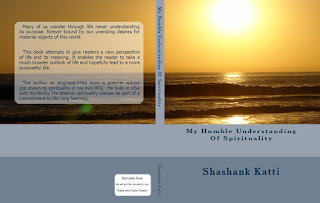
1. My Humble Understanding  Of Spirituality


My Humble Understanding Of Spirituality


2. Attain Infinite Bliss

Attain Infinite Bliss - A Spiritual Guide


3. The Spirit Of Spirituality

The Spirit Of Spirituality


Tuesday, May 26, 2015

The Real Cleansing To Absolute Purity

We have often heard the words, Cleanliness is next to Godliness. Most of us have kept our bodies clean, our houses clean, our vehicles clean and many other physical objects with which we are in contact. We smugly congratulate ourselves on our cleanliness and sneer at the dirt in many third world countries or in poor neighborhoods. But, let us reflect back on the so called cleanliness that we feel is the end of our quest for cleanliness.

Are we free of mass murders, gang rapes, jealous colleagues, angry spouses etc? If we are honest, our answer is a resounding NO. I am not speaking rhetorically here, nor am I am trying to become a preacher and tell people how to live. I will, as the article progresses, try to draw attention to the real dirt we should be cleaning, the impact of not cleaning and techniques for cleaning. When we talk of a despot doing mass murders, what should we look to clean? For a person jealous of his colleague and plotting some political game for his downfall, what should we clean? Surely not the physical body ! No amount of soap, shampoo or detergent can cleanse this.

Before deciding on cleaning, should we not look at the source causing the dirt in the first place? We can spend millions cleaning up a dirty pond. But if the factory nearby continues to pour its waste into the pond, how can we ever clean the pond? The solution is to either cut off the inflow of dirt from the factory or to clean the factory process to eliminate dirt. Either way, the solution is not where the dirt is seen, but in the source causing the dirt. This is obvious, one may yawn and say. But then, for the type of human dirt, I mentioned above, what is the source?

To understand this, we have to understand basics of any action. Action does not happen in a vacuum. Action is preceded by a desire and desire is preceded by a thought. So, for a dictator, there has to be a desire to kill and before that a thought of killing should arise. This process of thoughts and desires happen in our subtle body and is controlled by the Mind. The mind is relentlessly active with tens of hundreds of thoughts, some of which translate into desires, which the mind then commands the action organs to fulfill.

In addition to creating havoc on the outside world, an impure mind has a more deleterious  effect on the individual. As stated earlier, each of us is nothing but the Supreme consciousness. It is the mind that creates an illusion of separation and causes all the problems we face. As the mind becomes cleaner, it is able to reflect the pure consciousness better and be able to direct all action towards realizing the oneness of the individual with Supreme. An impure mind cannot do this. As human beings, we are the only species which can think and analyze and take steps to achieve the ultimate purpose of human life, which is to realize the Oneness with the Supreme. Without this, we are doomed to multiple lives of sorrow and suffering.  

So, if dark or bad thoughts arise in the mind, some of them get converted to burning desires which then get converted to dark actions. So, just as we had to cut off the flow of waste into a pond or clean the factory waste  so as to keep the pond clean, the only way to clean the dirt of violence, rape, anger etc is to cut off such thoughts in the mind or to fill the mind with good thoughts. It is not possible to have a mind that is empty of thoughts just as it is impossible to have an ocean without waves. The only way a mind can be cleaned of bad thoughts is to gradually replace it with good thoughts. But how can this be done? There are a variety of techniques to ensure that the mind is occupied with something good and prevent the rising of bad thoughts.

1. Visit to holy places

A visit to a holy place like a temple, church or whatever place depending on the individual belief will potentially reduce the flow of bad thoughts and encourage the flow of good thoughts. It could also include places of pilgrimage. The sheer exposure to so many people in a worshiping mode can potentially replace bad thoughts with good thoughts.

2. Attending lectures on spirituality

Any action that will ensure that the mind does not think of bad thoughts is a positive to reduce negative action. While it  is fine to even attend a lecture on physics, maths or on any worldly topic, it is better to attend lectures on spirituality, philosophy so that the mind at least gets exposure to higher aspects of life.

3. Doing social work

Whether a social work is done with a pure intention to serve or not, the very act of doing service to others, will create flow of thoughts that are positive and curb the negative thoughts.

4. Reading uplifting books

Again, so long as a good book is read, be it physics, history or whatever, anything that takes the mind away from negative thoughts is a big plus. However the  most benefit can come by reading books about morality, spirituality, biographies/autobiographies of great people.


The level of effort needed to clean the mind depends on the personality of the individual. Assume we have a mirror with a thin coating of dust. To make it reflect properly, all that is needed is a gentle wipe with a cloth. Similarly for people who are at a significantly high level of positive thinking, a simple prayer daily may help remove lingering negativity. These are technically called as Satviks or those who have a predominance of Sattva or goodness. Then, there are the next set of people who are not so evolved on the good thought scale and probably have a significant proportion of bad thoughts. These people are like a reflecting mirror which has been disused for a long time and has cobwebs and dust covering it up. So a gentle wipe with a cloth may not be enough. The glass may need to be cleaned with a jet of water and then wiped so as to reflect well. Similarly, for such people, a simple prayer may not be enough. They may have to follow a couple of methods from the list above, like reading a book daily and attending lectures daily. Such people are called Rajasik. Finally we come to another class of people who are totally steeped in ignorance. They do not care for anything or anyone's advise. They are like a mirror which not only has been disused, but has been exposed to so much dirt, that it has a thick coating of grime on it. For such a mirror, even a jet of water may not be enough. It may need chemicals to melt the grime and then water to clean and then a polish to restore the surface. Similarly for the absolute Tamasik people, it is unlikely that any of the above methods could work. They may need all of it. However, since they are so deeply ignorant, they may need to be forced into doing those activities. Just as a animal is trained using the carrot and stick approach, such people may need a mixture of pressure and gentle persuasion to get them on the path and once on the path, all of the above to make their minds clean.

This article broadly covered the necessity of cleaning the mind, the ways to clean the mind and the type of methods to be used depending on personality types. Readers are encouraged to mull over the article and after reflection, select the best method for cleaning their minds.


As readers may be aware, 3 of my books on spirituality are available on Amazon.com.

I invite readers of my blog to try any of the books and give me feedback so that I can make changes in the next edition.


1. My Humble Understanding  Of Spirituality


My Humble Understanding Of Spirituality


2. Attain Infinite Bliss

Attain Infinite Bliss - A Spiritual Guide


3. The Spirit Of Spirituality

The Spirit Of Spirituality


Thursday, October 31, 2013

Introduction To Meditation


Please read my book on spirituality which is available on Amazon.com.
------------------------------------------------------------------------------------------
Whenever any spiritual discussions come up, one point that is surely brought up is about meditation. Many times, when people ask me how I am and I say I am fully relaxed, one of the most common questions is whether I meditate. Meditation means many things to many people. In this article, I will try to give my understanding of what meditation is and whether it should be done.

Before going deeper into meditation, let us pause for a while and recapitulate some of the first principles of the path to enlightenment. I have covered earlier about the three principle routes for a practitioner in the field of spirituality. They are:

1. Karma yoga, the practice of doing every act as an obligation to society and for a higher cause than self gain
2. Bhakti yoga, the practice of living a life of gratitude and attributing every personal success to the people who made it possible
3. Jnana yoga, the practice of discriminating between the real existence which is Brahman and the unreal existence which is this colorful world.

 Now, as one progresses on the above paths, there is s subtle. slow but sure change that happens to a practitioner. His association with anything that is connected to the physical/emotional/intellectual world reduces.  Now, we know that nature abhors a vacuum. As the above practice continues, the vacuum increases and in cases where the practice is done without the proper guidance of a spiritual teacher, there is the likelihood of a person slipping into a disinterested, carefree type of life. These are the type of stories we hear in some types of spiritual camps, where ultimately the people end up in drugs or in some extreme cases even mass suicide, because the anchor that holds them to this world is loosened and there is nothing else for them to hook on to.

All this would happen if the practice is not done under the control of the intellect. Many often in conventional religion, focus is given on Bhakti and Karma. Almost every religion says we should glorify the Lord, praise the Lord, do good tings, not to be selfish etc. Very few focus on building the intellect. Again, I would like to differentiate between Intelligence and Intellect. I am not talking of intelligence gleamed from studying books. I am talking of the Intellect which independent of intelligence acts as a beacon to everyone if properly trained and used. This is where the fourth part of the practice, Dhyana Yoga or meditation comes in.

Through Jnana yoga, we realize that we are not the body/mind/intellect with which we most often associate ourselves. Jnana yoga tells us that there is something much beyond all this called the Brahman and that is my true reality. But just learning about this is of no use. At some point the reality has to fully sink in to become enlightened. I am telling all this to talk about countering the void that could come due to practice of Karma yoga and Bhakti yoga without the guidance of the intellect. With the intellect's guidance, in the absence of association with body/mind/intellect, a practitioner can fill the void with the thought that his association is with the Supreme Brahman.

Let me plot a graph with Time on the X-axis and association with the individual body mind intellect as one parameter on the Y axis and another being  association with the Supreme. Initially my association is highest with my body/mind/intellect. Hence at time 0 or at beginning of the spiritual practice, the graph starts at the highest point on the Y axis.  At the same time if we look at our association with the Supreme, it is almost at zero level and hence this graph starts at the bottom of the Y axis. As time progresses and my practice of Karma yoga and Bhakti yoga continues, there is a gentle drop in association with the worldly objects and this graph begins a slow descent. At the same time assuming there is an intellect governing the spiritual practice, there is a slow uptick in association with the Supreme and with passage of time, this graph starts looking up.

Now to the question of meditation. Should it be done? During the stage when the practitioner is full of desires, any attempt to meditate will be pointless. Meditation is to be done to realize the essential unity of myself with the Supreme. As can be seen based on the graph I explained above, in the initial stages of spiritual practice, the gap between identification with objects and with Supreme is very wide and may not be found suitable to achieve any tangible benefits. As time progresses and the two graphs progress, with the graph of physical identification dipping and the graph of Supreme identification rising, the gap between the two keeps decreasing and at some point, the two intersect, at which point the seeker is in a perfect state to focus on meditation to further their spiritual awakening.

Does it mean that till the point above is reached, one should not meditate? I am of the opinion that there is no harm in meditating so long as the objective is clear and one is ready to face the consequences, if any of meditation. One is advised to seek out a calm lonely place and select a fixed time every day to do meditation. There are several techniques suggested for meditation. Some of them are as follows:

a.Taking an image of a favorite God or angel or spiritual teacher and try to focus thoughts on that
b. Focusing on one's own shadow in the mind
c. Focusing on one 's own image as though in a movie
d. Focusing on a word or "shloka"
e. Focusing on one's own heartbeat
f. Focusing on one's own breath

There is no single technique that can be good for everyone. Readers are encouraged to try any of these and see what works best for them. During initial phase of meditation, it is almost impossible to focus the mind. The nature of the mind is to wander and create thoughts. So a practitioner can become disillusioned about the absolute lack of progress.  But this is very normal. The best strategy is to let the mind wander, but try to be aware that the mind is wandering and slowly bring the mind back to focus. The other issue that is seen as meditation continues is the type of thoughts that crop up. One shudders as to the type of thoughts that come up. This is again natural. Each of us has myriad desires buried in our mind. So long as the mind is active in the physical world, these are suppressed by the normal physical thoughts. But in meditation, when the mind is silent, these hidden desires or vasanas sprout thoughts which may make the practitioner feel disgusted. Again this is natural and should not discourage the practitioner. The strategy is to be aware of such thoughts as they arise and observe them as they pass through the self. The idea is to be non-judgmental and just observe the thought as a third person.

I mentioned earlier that real benefit of meditation comes in a very advanced stage and till that point, it may be useless. So, what is the point of meditation till then. I would see the following benefits:

1. A sense of discipline: Just as a regular physical exercise is a discipline that keeps the body fit in the long run, meditating regularly is a discipline that enables one to keep the mind fit for the long run.
2. A sense of calmness : All the while we are focusing our mind outwards and getting frustrated in the illusory world.Meditation turns the mind inwards generating a sense of calm.
3. A sense of positiveness : During meditation, especially focused on breath, if thought is of all positive things coming in as I inhale and all negative things going out as I exhale, there is a feeling of positiveness.

I encourage readers to mull over this article and give me feedback on their own experiences with meditation.

As readers may be aware, 3 of my books on spirituality are available on Amazon.com.

I invite readers of my blog to try any of the books and give me feedback so that I can make changes in the next edition.


1. My Humble Understanding  Of Spirituality


My Humble Understanding Of Spirituality


2. Attain Infinite Bliss

Attain Infinite Bliss - A Spiritual Guide


3. The Spirit Of Spirituality

The Spirit Of Spirituality


The Holy Bhagwad Gita - My Journey

Introduction Today, on the auspicious occasion of Gita Jayanti, I am humbly penning down my journey with the Gita.  The celebration of holy ...