Showing posts with label Arjuna. Show all posts

Sunday, February 21, 2016

The Logic of the Emotionally Disturbed Mind

Arjuna uvaacha

katham bheeshmamaham sankhye dronam cha madhusoodana |
ishubhihi prati yotsyami poojaarhaavarisoodana || 4 ||

guroonahatvaa hi mahaanubhaavaan shreyo bhoktum bhaikshyamapeeha loke |
hatvaarthakaamaamstu guroonohaiva bhunjeeya bhoogaanrudhirapradigdhaan || 5 ||


Transalation

How can I, O Madhusoodana, fight against Bheeshma and Drona with arrows? Both of them are worthy of worship, O destroyer of enemies.[2.4] I will not kill my revered teachers, because in this world, I would prefer to partake of food received through alms, rather than enjoy the blood-stained worldly pleasures derived from killing my teachers.[ 2.5] To conquer them, or to be conquered by them, I do not know which is the better of the two. Dhritraashtra's kinsmen, after killing whom we certainly don't wish to live, stand here before us.

Summary

Let us briefly recap the context of this verse. The Mahabharatha war is about to begin. Arjuna, the ace archer of the Pandavas on seeing his own kith and kin arraigned against him on the enemy side, loses his emotional stability and refuses to fight. We have also seen from the earlier verses, that he is in a hyper stressed situation and is not able to think clearly.

Strangely, even in this situation, he gives out arguments justifying his reason for not fighting. As can be seen from this verse on to the next couple of verses, the arguments seem cogent. We have discussed earlier about the structure of an individual consisting of the body, mind and intellect. Looking closely at the last two, the mind is full of emotions and can never decide. It is the intellect which acts as the guiding principle and advises the mind. But in several situations, the emotions are so powerful that they cloud the intellect. Without the intellect, the mind seemingly takes decisions. But without the guidance of the intellect, it is not a good decision. However, since the intellect is blinded, one does not even know the thinking or the decision is wrong and believes that the emotion driven mind is talking logically.

This is the same set of strong conviction brought about by an emotion driven mind, without the guidance of the intellect, that makes people commit heinous crimes.Even Godse, after he killed Gandhi had very logical arguments to support his stand. By most analysis of rational thinking, this argument could be invalidated. But being in an emotional state, the logic to eliminate Gandhi, would have appeared totally logical to Godse and made him pull the trigger.  Imagine a former president of USA having a torrid affair with an intern in his own office. Would a sane man holding a powerful office do something so crazy in normal circumstances? It was again a passion driven mind clouding the intellect, which gave seemingly convincing arguments to go ahead and do something insane, in normal circumstances.

The emotions clouding the intellect extends to non-heinous crimes too.  Look at the various office crimes including money laundering, embezzlement etc done by reputed people. We had the top executive of Mckinsey, a top class management consulting firm getting embroiled in an insider trading case and being jailed. 
Now, why would a rational thinking highly respected executive take the totally crazy step of doing a criminal act? Would he not have known the consequences of this act? Again, he was overtaken by emotion of greed, power or whatever, which clouded his intellect and the emotion driven mind gave apparently strong arguments which convinced him that it was fine to go ahead.

In summary a weak mind by definition  is that which is having or showing a lack of mental firmness. It is irresolute and vacillating. But it has the troubling ability to cloud the intellect and prevent right thoughts and action.  In a hyper stressed / distressed state , the mind will put forth a lot of arguments These arguments may  appear logical. But remember, these arguments comes out of a weak mind. There is no virtue / value in the arguments of a weak mind.

But as we said, a man in this emotional state will not even know that his intellect is clouded and his arguments are not right. What is the way out then? We will see that in the next blog post.


3 of my books

As readers may be aware, 3 of my books on spirituality are available on Amazon.com.

I invite readers of my blog to try any of the books and give me feedback so that I can make changes in the next edition.


1. My Humble Understanding  Of Spirituality


My Humble Understanding Of Spirituality
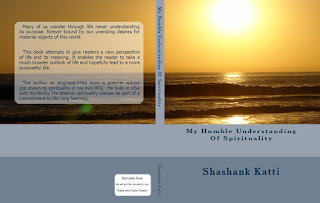


2. Attain Infinite Bliss

Attain Infinite Bliss - A Spiritual Guide


3. The Spirit Of Spirituality

The Spirit Of Spirituality


Wednesday, September 30, 2015

A Individual Overcome By Emotions


arjuna uvāca

dṛṣṭvemaḿ sva-janaḿ kṛṣṇa
yuyutsuḿ samupasthitam
sīdanti mama gātrāṇi
mukhaḿ ca pariśuṣyati


Arjuna said: My dear Krishna, seeing my friends and relatives present before me in such a fighting spirit, I feel the limbs of my body quivering and my mouth drying up.

vepathuś ca śarīre me
roma-harṣaś ca jāyate
gāṇḍīvaḿ sraḿsate hastāt
tvak caiva paridahyate

My whole body is trembling, my hair is standing on end, my bow Gandiva is slipping from my hand, and my skin is burning.

na ca śaknomy avasthātuḿ
bhramatīva ca me manaḥ
nimittāni ca paśyāmi
viparītāni keśava

I am now unable to stand here any longer. I am forgetting myself, and my mind is reeling. I see only causes of misfortune, O Krishna, killer of the Keshi demon.


na ca śreyo ‘nupaśyāmi
hatvā sva-janam āhave
na kāńkṣe vijayaḿ kṛṣṇa
na ca rājyaḿ sukhāni ca


I do not see how any good can come from killing my own kinsmen in this battle, nor can I, my dear Krishna, desire any subsequent victory, kingdom, or happiness.


Commentary :

These verses brilliantly illustrates the helplessness of our self-control and the corresponding impact on our body and mind. When we face a tough situation, we find it difficult to exercise our own self-control because of our love, affection, fear and addiction to negative thoughts and emotions.

The scene is the Kurukshetra war where the opposing armies of the Kauravas and the Pandavas have gathered for a battle royal.

From an event perspective, just before the battle begins, Arjuna requests Sri Krishna to take the chariot between the 2 armies so that he can get an idea as to who are in the opposing armies. The all knowing Krishna takes the chariot right in front of the revered Bhishma, Drona etc. Bhishma is Arjuna's great grandfather and Drona is his revered teacher, both unfortunately being opposed to Arjuna now due to their prior obligations to Duryodhana.

Arjuna looks at the revered elders in front of him and his numerous cousins with whom he has played as a kid, now standing before him in battle. A wave of emotion overpowers Arjuna and he goes on a long lecture as to why it is not right for him to fight the battle.

Let us try and analyse the situation from different angles. First from the situational angle, here is the greatest warrior Arjuna who has done hundreds of battles and has been preparing for the greatest battle for the past 13 years, and he has broken down totally on seeing the people he is going to fight. Arjuna knew that he would have to fight his guru and his elders. It was not a surprise for him. but seeing them actually on the battlefield and the thought that his arrows could kill them totally threw him into a disarray. He totally forgot the purpose of the war and his duty and was overcome by emotion. His duty was to dislodge the Kauravas from the empire of Kurukshetra. It was not for the desire of kingdom that Lord Krishna wanted him to fight the war. Rather it was always known that the war was a righteous war to establish Dharma or proper conduct in society. The Kauravas were bad rulers climaxing in the utter horror of the crown prince attempting to disrobe a princess in the palace in the presence of elders. How much could society have degraded that it stood still watching such a scene and did nothing about it. It was Arjuna's duty as a warrior to fight evil tendencies and help establish a moral code of conduct. However as soon as he saw the people, he forgot that objective and the only thing that was in his mind was his keen selfish desire to preserve his kith and kin. From that perspective it was a massive fall for Arjuna from the lofty ideals of war to uphold righteousness to a selfish desire to protect his kin from certain death in the war.

Let us now look at it from a psychological perspective. Here was Arjuna, a towering warrior with a rich intellect overpowered by emotions. In this emotional state, Arjuna was finding enough reasons for not fighting, all within the control of emotions and not by the reasoning of the intellect. Most often than not, does it not happen to us that when we face a crisis situation, we are totally guided by the emotion rather than the intellect? Emotions, by themselves are not bad at all. They provide us a means to express and enjoy the rich tapestry of life. But emotions primarily consist of like(Raga) or dislike(dvesha) of something. Getting what we like makes us happy and losing what we do not like makes us happy and vice-versa. So, if any major act of ours is driven by emotion, in effect it is driven by our individual likes and dislikes and not by reasoning born of intellect. Such an act based on emotions is likely to lead to bad results. Just as Arjuna driven by emotion, deciding not to fight, would have meant a sure victory for the evilness of the Kauravas, our own actions driven by spurts of emotion can lead to actions with disastrous results. Seeing the fact that the destructive emotions are part and parcel of our own personality, our self-control find it difficult to act against them. Self control concludes that life without these thoughts and emotions is meaningless.
When we face a stressful situation, the perception will be sent to our thinking and emotional brain at the very same time through the thalamus. If the emotional brain finds a threat in the situation perceived, it hijacks our thinking brain ,may go to a fight, flight or freeze situation. The emotional response "can take over” the rest of the brain in a millisecond if threatened.

This challenge with the emotions overpowering the intellect and making self control powerless will manifest in different ways in our body and mind :

  • Body Shivering
  • Dry mouth
  • Burning sensation in skin
  • Cannot stand properly
  • Mind spinning
  • Hair stands up
Psychologically, when we are taken over by emotions in a stressful situation, the following typically happen:


  • Feelings of helplessness and hopelessness. A bleak outlook—nothing will ever get better and there’s nothing you can do to improve your situation.
  • Loss of interest in daily activities. No interest in former hobbies, pastimes or social activities. You’ve lost your ability to feel joy and pleasure
  •  Appetite or weight changes. Significant weight loss or weight gain—a change of more than 5% of body weight in a month
  • Sleep changes. Either insomnia, especially waking in the early hours of the morning, or oversleeping (also known as hypersomnia).
  • Anger or irritability. Feeling agitated, restless, or even violent. Your tolerance level is low, your temper short, and everything and everyone gets on your nerve
  • Loss of energy. Feeling fatigued, sluggish, and physically drained. Your whole body may feel heavy, and even small tasks are exhausting or take longer to complete
  • Self-loathing. Strong feelings of worthlessness or guilt. You harshly criticize yourself for perceived faults and mistakes
  • Reckless behaviour. You engage in escapist behaviour such as substance abuse, compulsive gambling, reckless driving, or dangerous sports
  • Concentration problems. Trouble focusing, making decisions, or remembering things
  • Unexplained aches and pains. An increase in physical complaints such as headaches, back pain, aching muscles, and stomach pain.

Now let us look at this from a spiritual perspective. As a spiritual seeker, we are told that we have to give up desires, ego, past habits etc. Just as Arjuna felt that it is not worth fighting for a kingdom and winning it by defeating Duryodhana, we convince ourselves that it is not worth living if we give up all desires(Duryodhana).

Have we not heard enough arguments that without desire there is no progress and we should all aim higher and higher for physical/mental/intellectual desires? Having been conditioned by society that desires are essential, when we as spiritual students are told that we have to fight desires, we feel the spiritual path which is advocating giving up desires is not worth it. Arjuna could not face up to the fact that his arrows could kill Bhishma. Similarly we cannot face up to the fact that our arrow of intellect got through spiritual progress can kill our ego.


In summary, just as Arjuna, with clouded intellect, gave emotional reasons not to fight refused to fight with Duryodhana whose army consisted of warriors like Drona and Bhishma, we in our fit of ignorance of reality, give apparently convincing reasons not to fight desires whose army consists of warriors like ego and past habits and give up the path of spiritual progress.


------------------------------------------------------------------------------------------

3 of my books

As readers may be aware, 3 of my books on spirituality are available on Amazon.com.

I invite readers of my blog to try any of the books and give me feedback so that I can make changes in the next edition.


1. My Humble Understanding  Of Spirituality


My Humble Understanding Of Spirituality


2. Attain Infinite Bliss

Attain Infinite Bliss - A Spiritual Guide


3. The Spirit Of Spirituality

The Spirit Of Spirituality


Saturday, September 26, 2015

Emotion Overcomes Self Control

sañjaya uvāca evam ukto hṛṣīkeśo guḍākeśena bhārata
senayor ubhayor madhye sthāpayitvā rathottamam

bhisma-drona-pramukhatah sarvesam ca mahi-ksitam
uvaca partha pasyaitan samavetan kurun iti

atrāpaśyat sthitān pārthaḥ pitṝn atha pitāmahān
ācāryān mātulān bhrātṝn putrān pautrān sakhīḿs tathā

śvaśurān suhṛdaś caiva senayor ubhayor api
taansameekshya sa kaunteyaha sarvaanbandhunavasthitaan


Sanjaya said: O descendant of Bharata, having thus been addressed by Arjuna, Lord Krishna drew up the fine chariot in the midst of the armies of both parties.

In the presence of Bhishma, Drona and all the other chieftains of the world, the Lord said, Just behold, Partha, all the Kurus assembled here.

There Arjuna could see, within the midst of the armies of both parties, his fathers, grandfathers, teachers, maternal uncles, brothers, sons, grandsons, friends, and also his fathers-in-law and well-wishers.

When the son of Kunti, Arjuna, saw all these different grades of friends and relatives, he became overwhelmed with compassion and spoke thus.

Commentary

To set the context, Arjuna, the archer has requested his charioteer,  Krishna to take the chariot between the two armies so that he could see the warriors assembled on the opposing side. Krishna then takes the chariot as requested and points out to Arjuna the various warriors including his great great grandfather, Bhishma, his teacher Drona, his cousin Duryodhana and various other relatives.

We have seen earlier that Arjuna represents self control and Krishna represents the supreme intellect in us. We have also seen that self control needs to be aware of the negative forces it has to battle in its journey. The intellect in us points out to us the negative forces. It shows us the main negative force which is Ego(represented as Bhishma), our past habits which drive our behaviour(represented as Drona), our material desire(represented as Duryodhana) to name a few.

Just as Arjuna on seeing his near and dear ones he would have to battle, felt remorseful, in exactly the same way, our self control behaves when it sees the negative forces in the mind. One may wonder why negative forces should cloud the self control. Let;s try to look at some of the negative forces we have to battle in our journey of self evolution. I mentioned ego as one of the negative forces. Have we all not been trained since almost birth that we have to have a identity different from others? Have we not been almost always taught that we should always try to become better than others? again none of these are bad in the materialistic world and are essential too. However for a spiritual journey, the feeling of separateness or the feeling of difference from the supreme which is the ego's creation, is what we are trying to eliminate. The ego has become us. I identify myself as a particular religion, group, caste whatever and when self control says, here is your enemy, we are struck with horror. If I fight ego and give it up, what becomes of me? Don’t I become a non-entity?

Intellect points and shows desire as one of my negative forces. Again it is a shock for me. It is a desire for a better life that has brought me here. It is a desire for the next BMW that makes me work hard. It is a desire to get that fat bonus that propels me. What would I be without desire? Without desire I am non-existent.

Some of the negative forces may have developed through conditions of environment. A child does not come into the world as a drunkard. But suppose it is in the company of parents/elders who always drink, then it sees nothing wrong at all in that and drinking is accepted as a part of life. Some of these negative traits may be acquired as we grow in life.  I may have casually started smoking for fun and without realizing it has engulfed me and become part of me. These are all habits which reinforce desires and are bound closely to my personality. When the intellect points out to habit as a negative force, I am stunned and if told to give up habits, I feel distressed since they have become part of me.

Conclusion

Negative forces to be controlled are  part and parcel of our psyche and it’s very hard for us to control or annihilate them as they are deep rooted and very dear to us. As discussed, some of these impressions might have been developed by the influence of the family. Some of them might have been from the society and culture we are born. Some of them might have been developed by our own misinterpretations. The negative thoughts / emotions / habits present themselves as near and dear to us. 

------------------------------------------------------------------------------------------------------


3 of my books

As readers may be aware, 3 of my books on spirituality are available on Amazon.com.

I invite readers of my blog to try any of the books and give me feedback so that I can make changes in the next edition.


1. My Humble Understanding  Of Spirituality


My Humble Understanding Of Spirituality


2. Attain Infinite Bliss

Attain Infinite Bliss - A Spiritual Guide


3. The Spirit Of Spirituality

The Spirit Of Spirituality


Monday, March 16, 2015

Introduction To Bhagwad Gita - Chapter 1


Human Bondage


If we think deeply and question what is it that we as humans value the most, what could be the likely answer? This is assuming that all basic needs like food, clothing, shelter, security are ensured. Again surely, this could be a highly individualized desire. Someone may say that if they have a good spouse and a happy family, that's what they value most. Another may say, wealth and a third may say power or position. Let us take an imaginary situation. Assume the person who values his spouse and family as the most, if the family were to be imprisoned in a jail, would he be happy? At this point, he has his family which he values the most. So, why should it matter if all of them are in a jail or house arrest with no freedom to move around? Same is the case with the person who has phenomenal wealth. If he was told that he could spend his wealth only on a select few items or else just keep it, how happy would he be? Surely he should be since he values his wealth and he has it. Only thing is he does not have is freedom to spend it the way he wants.

What we can notice is that in spite of having what is supposedly valued the most, the inability to have a free choice makes an individual unhappy and not fully able to enjoy the most valuable thing that he or she has. In a similar vein, what is it that entire societies or countries desire the most? India desired freedom to determine its own destiny and broke free from British rule. Similarly, the blacks in South Africa desired freedom of expression and broke the tyranny of White rule. When India got independence, the entire country erupted in joy. When Perestroika happened and the Eastern bloc people tasted democracy, their joy was unsurpassed. So, if we look at these cases, it is apparent that independence or free will with an ability to express oneself freely without any bondages is what truly every human being desires and deserves.

Lurking behind our sense of freedom is a vicious invisible bondage which curbs our ability to truly express ourselves. I can almost sense the disagreement among readers telling that they are totally free to do anything and act the way they want. Let me give a couple of examples and then we will decide whether a human being is really free.


Case 1: Encounter in office


Mr X, a senior executive in a MNC is getting ready for work and is expecting to eat his choice breakfast before he leaves for work. His wife accidentally has burnt the toast which gets Mr X to accuse her of neglect while cooking. She responds back telling she had to get the child ready for school. Conversations and accusations flow between both of them and finally in anger, Mr X smashes the plate and walks out. He gets into his car seething with anger and reaches office and he has a meeting. In the meeting, one of his colleagues makes a suggestion which runs counter to X's ideas. X immediately breaks into a rage and shouts at his colleague. X is normally known as a pleasant person and everyone is shocked at the outburst.

Let us analyze this. Did X want to shout at his colleague? Was it really the fact that his colleague had a different view so angered X? What was driving X to react the way he did? Is it not obvious that X's behavior was clouded by the anger emotion that he was carrying from his fight at home? To that extent, was X really free in his interactions with his colleague or was he bound by emotions? It is clear to anyone that X was not free. The anger emotion had so bound and blinded X that he totally reacted negatively to a routine office situation.

Case 2: The beautiful flower in the party

Y is a hardworking smart lady and is seen as an excellent worker. She has a loving father at home who one day decided to surprise his daughter and went to the florist and bought a bunch of red roses. As he was walking back home he felt faint and as he fell, he was hit by a passing vehicle and he was hospitalized with serious injuries which kept him paralyzed for life. The thing that kept on hurting Y was the fact that her father had bought her red roses and and as he was bringing them, he had this accident. Several years later, when Y was promoted, there was an office party with lot of congratulations and fun. Then one of the colleagues went to her and presented her a bouquet of red roses. Y immediately became sad and broke into uncontrollable tears.

Now what made Y become so sad? It was a joyous occasion when she had to be enjoying her success. But the reality of the situation was clouded by the emotion of the red flowers. This emotion and thought of her paralyzed father prevented her from enjoying the current environment. The red roses based emotion bound her to a past sadness and prevented her from being happy in the current.

Case 3: The GMAT exam day

P is a loving kid and he has been pampered by his parents, grand parents and his various uncles and aunts. He is a smiling kid, well behaved and does well at school. His only dread in life is being separated from his loved ones. P has studied well and after finishing his engineering studies, has been preparing for the GMAT. His dream is to do an MBA from Harvard and for that he has been incessantly preparing. On the day of the exam, his maternal uncle has dropped him off at the exam center. As P enters the exam hall, he is full of dreams of cracking the GMAT. He sits down at his desk waiting for the exam paper. He thinks of himself cracking the paper, of getting admission to Harvard and he getting ready to leave the country to go to the US. He imagines himself at the airport surrounded by all his loving friends and relatives. Then it suddenly hits him. He is going to go far away from all his loved ones. He will not be able to see them whenever he wants and who knows whether his grandparents will be alive or not when he returns. As he thinks of it, sadness envelops him and he sits motionless. The examiner hands him the question paper. But P's hands are barely moving. He is just not able to focus on the task. His thought is only of separation from his loved ones and he feels he should not even attempt answering the paper since that can take him far away from his loved ones.

What made P who was preparing so ardently for the GMAT sink into a helpless state? For something that he had been dreaming of, why did he suddenly develop a disdain? Inspite of being a brilliant person, why could he not focus and crack the question paper? It is obvious that his free will was bound by emotions, the emotional pain of separation.

Emotions and the intellect


To understand what is happening, we need to briefly understand the structure of a human being. We have a body consisting of the five sense organs and five action organs; We have a mind which emotes and an intellect that thinks. The sense organs send cues about sense objects to the mind, which directs the sense organs to go towards the sense objects for fulfillment. It is only the intellect which provides the discerning ability and guides the mind. Just as a car needs a good driver to avoid accidents, the mind needs to be under the control of the intellect to ensure that the body goes in the right direction. In a situation where the intellect is not in control, emotions take over and can lead the body in the wrong direction, very similar to a drunk driver potentially taking a car to a disaster.

So in all the above cases we have seen that emotions have taken control over an individual and he is not being guided by the intellect. He is bound by emotions and cannot exercise his free will. Nor does he know whether he is doing the right thing or not. Our mental state determines the way in which we perceive, feel, think or act in a given situation. Most of the times, mind is not in a well placed state. There is a constant conflict between discriminative thoughts and destructive emotions We are confused and disturbed when facing challenges with an inability to focus or concentrate on the problem in hand 

Problems associated with emotional bondage


Some of the problems associated with emotional bondage are as follows:

  •     We cannot perceive the situations as it exists. Rather, we see them as interpreted by our unsteady mind which may be different from the reality. The interpretation of the same fact may vary from time to time depending on our mental state.
  •     Our mood or state of mind is not in our control. As a result our behavior in the world outside is not in our control
  •     We cannot consistently express our full potential in the activities we do, making our inner peace and external efficiency a mere chance.
  •     We cannot bounce back to life easily after facing a difficult situation which is not in our hands

Gita, Chapter 1 : A Masterly Self Analysis


The situation described above is the context of the first chapter of the Gita. Two sets of cousins are on the battlefield with their massive armies to get control of the kingdom of Hastinapura. On one side are the Pandavas who have been cheated from the throne and banished to the wilderness for 13 years by their cunning cousins and on the other side are the Kauravas who have cheated the Pandavas and have been ruling Hastinapura. The chief archer on the Pandava side is Arjuna who has been practicing archery ardently so that he can defeat the Kauravas. He requests his philosopher and mentor Sri Krishna who is also his charioteer to take him to the middle of the battleground so that he can see the people on both sides. Seeing his cousins,uncles, grand uncles on the other side, Arjuna is overcome by emotion of losing them all as he fights them and he lays down his arms and refuses to fight. His emotions have totally taken over control and even though he knows he is here to fight a just war to regain the kingdom, he uses all the logic given by his emotions to justify not fighting.

Using Arjuna as the protagonist, the first chapter gives a brilliant exposure to self analysis. It is for each of us to reflect on Arjuna's arguments to justify not doing the right thing and see how we relate to that in our day to day lives. By clearly showing the problems associated with our mind, self analysis helps us to make a cognitive change which can make a significant impact to our internal mental state and our ability to perform in the world outside. This self analysis helps us to identify and understand the problems associated with our own mind. Self Analysis is the first step towards Self Improvement. Here the Gita tells us clearly that  a strong and well placed mental state is a prerequisite for our mental well being and for pursuing any goals in life. Each chapter of the Gita provides us a process for transforming our mind to the optimal mental state.

Solutions to most of the  problems are already there within us. In any counseling session practitioners use the Cognitive Behavioral Therapy or Brief Solution Therapy in order to change the patient’s mindset towards a higher good.  All solutions to each and every problem or issue that we face are very much dictated within us.  All we need to do is to calm our emotional mind and be able to see through the situation in order to get a clear view of the sources available within our own intellect to solve the problem. In the first chapter, The Gita provides us this valuable tool of self analysis.


As readers may be aware, 3 of my books on spirituality are available on Amazon.com.

I invite readers of my blog to try any of the books and give me feedback so that I can make changes in the next edition.


1. My Humble Understanding  Of Spirituality


My Humble Understanding Of Spirituality


2. Attain Infinite Bliss

Attain Infinite Bliss - A Spiritual Guide


3. The Spirit Of Spirituality

The Spirit Of Spirituality


The Holy Bhagwad Gita - My Journey

Introduction Today, on the auspicious occasion of Gita Jayanti, I am humbly penning down my journey with the Gita.  The celebration of holy ...