Showing posts with label happiness. Show all posts

Sunday, October 15, 2017

The 8 Step Path To Eternal Happiness - Ashtanga Yoga

Let me start this post with defining the purpose of human life. Is it just to acquire wealth, procreate, gain position, own big houses, cars, yachts etc ? One may say yes to all of above. But if we take a step  further and ask ourselves why we need all above. The answer would be , I need them because they make me happy. If we go further, do we need happiness for one hour, day, week etc, the obvious answer is we need eternal happiness. For most of my readers, the source of eternal happiness is known to be internal since we are the very embodiment of Peace and Happiness. However, by our wrong identification with our body, mind and intellect, the Divine Soul within which is pure and forever happy associates itself with feelings of sadness, pain etc and appears to be seemingly sad. So, the route to eternal bliss is not some far fetched road, but a road within our own hearts to discover our true self.  All this sounds good in an intellectual discussion, but is of no practical use to a seeker of the Infinite happiness. 

I can tell a budding boy the greatness of being a top seed tennis player and show him all the dreams. But that is just a pie in the sky. If I am serious about guiding him, I should show him the path to become a top seed player. I have to tell the boy about nutrition, about the type of bats, the techniques to play, the type of mental determination needed, the type of exercise needed etc. I also have to tell him how to progress from junior league to state league  to national to international league. 

In exactly, the same way, a seeker of Infinite Bliss needs instructions on how to prepare for the journey and how to progress on the journey. Many spiritual leaders have suggested their own paths for their followers. One such path which is very methodical and logical is Patanjali's Ashtanga Yoga. Patanjali, the great ancient exponent of Raja Yoga, wrote that the path to enlightenment embraces eight stages. This eight-limbed approach, known as Ashtanga Yoga is not to be mistaken as a step-by-step approach but a multidimensional approach in which all eight limbs are practiced simultaneously. 

The 8 fold path consist of the following:


  1. Yama
  2. Niyama
  3. Asana
  4. Pranayama
  5. Pratyahara
  6. Dharana
  7. Dhyana
  8. Samadhi

The 8 fold path is actually broadly categorized under two major headings:

  • Refining our personalities, gaining mastery over the body, and developing an energetic awareness of ourselves
    • The first 4 stages fall under this category
  • Controlling the senses, the mind, and attaining a higher state of consciousness.
    • The last 4 stages fall under this category

In this article, I am covering what each of the 8 stages mean. 


  1. Yama, deals with one's ethical standards and sense of integrity, focusing on our behavior and how we conduct ourselves in life. 
  2. Niyama, the second limb, has to do with self-discipline and spiritual observances. 
  3. Asanas, the postures practiced in yoga, comprise the third limb. 
  4. Pranayama consists of techniques designed to gain mastery over the respiratory process while recognizing the connection between the breath, the mind, and the emotions
  5. Pratyahara the fifth limb, means withdrawal or sensory transcendence. It is during this stage that we make the conscious effort to draw our awareness away from the external world and outside stimuli.
  6. Dharana, or concentration is the process to slow down the thinking process by concentrating on a single mental object: a specific energetic center in the body, an image of a deity, or the silent repetition of a sound.
  7. Meditation or contemplation is the stage where the mind has been quieted, and in the stillness it produces few or no thoughts at all.
  8. Samadhi, is a state of ecstasy when the practitioner has reached his ultimate goal and realized ultimate bliss.  
 In subsequent posts, I will go deeper into them.


------------------------------------------------------------------------------------------


Please buy and read any of these books which are available on Amazon.com.


My Humble Understanding Of Spirituality


Monday, August 29, 2016

3 Golden Sentences To Live Your Life Peacefully

If we look at one thing that is common for all living beings, it is that desire to be happy every moment. There is no other motivator for anyone to work, meet people, engage in hobbies etc. But how do we find that secret to happiness so that every moment of our's is filled with fulfillment and joy? Humanity has tried various means to remain happy including drinking, drugs, meditation, prayer and so on and so forth. But still, there is a craving, a sort of emptiness in our lives. Is there some way we can remember simple aphorisms/sentences which will transform us into happiness incarnate? I am sure great masters have come up with their own solutions which surely have benefited millions. In all humility, I submit the following 3 golden sentences to understand, reflect and internalize to gain happiness.

1. This too shall pass.
2. Let events happen.
3. I created this situation.

I. This too shall pass

Each of face events in our day to day lives and are affected by it. We buy a brand new luxury car and are thrilled. We lose a job and we are dejected. Do we all not know that change is a fact aof life and anything in nature is dualistic. We have happiness/sadness as two sides of emotions; we have light/dark as 2 sides of visual experience; Do we worry when day turns into night and become super happy when night turns into day? These are just natural events and by themselves have no cause to be either happy or unhappy. Similarly, in all our lives, what we assign as good or bad events will happen, whether we want or not and we have to stoically bear it by saying, "this too shall pass". Statistically, it is proven that most events tend towards a mean and there is almost no exception. It is impossible that someone is always having good events  and someone is always having bad events. For everyone measured over a period of time, they will balance out. So, while we may be very happy winning a lottery and bagging the largest contract, it is always good to temper that joy with the realization that, "this too shall pass." Similarly, we may lose a job, get a divorce, lose a loved one and be extremely sad. But even in that darkest moment, we can find succor by remembering, "this too shall pass".

Does this mean that by rote, I keep telling myself the above sentence? It will not help unless we understand the basis behind this sentence. Let's go to basics. Who am I? My readers by now know that the only reality is Brahman or Consciousness or Absolute Truth. There is nothing else other than this reality and each of us feel we exist separately due to massive primordial ignorance. IF my true nature is this absolute reality, then there can be nothing else. When there is nothing else, the dualities cannot arise. Once I know this, whenever an event occurs, it is like an event in a dream. Dream events come and go and I as the sleeper, is not affected by them.  Assume if there was some way to get inside my own dream and observe my dreams. When in the dream, I win a lottery ticket and overtake Bill Gates, my dream character will be supremely happy. But I, the observer will smile and say, "this too shall pass". Similarly, in the dream, I lose my job, then my dream character will be very sad. But I as the observer will smile and say, " this too shall pass".

Similarly, when I am the supreme consciousness and due to my "ignorance" I experience good and bad events, it is easy to be an observer and say, "this too shall pass".

II. Let events happen

If there is one major thing that bothers most of us, it is anxiety about the future. I have just given a proposal for a major deal. will I get the deal or not? I have just given an interview. Will I get the job or not? All of us, by and large, are anxious about the future. Some of us may go to astrologers or soothsayers or so-called psychic readers to know what the future will be. But will any amount of my anxiety or visits to anyone change the final result? If I have done badly in an exam, will my being anxious change anything? But in being anxious, what are we losing? We are losing the ability to be happy and enjoy life between the time an event occurs and till the result comes.Even if I have done well in a task, most of us are anxious and in effect, unhappy. I can hear people saying, no, we are not unhappy. Happiness is defined as a state of peace. Obviously, when we are anxious, we are not peaceful and hence not happy.

So, what is the way out? Let events happen ! Again , it is easy to say, let events happen. Does it mean that I do not have any personal responsibility and I am just a twig in a river, being carried around by its currents? An emphatic NO !

I am responsible for the action only. If I have to give a proposal, I am responsible for ensuring that the solution is correct, the price is correct and it fully meets the expectation of the client. Once I have put in my best and submitted, it is pointless to be anxious. Anxiety arises when there is a doubt in what I have done. As several seers have told, the Universe rewards positivity and conspires to make positive things happen if we are resolute. If I have done a good job and I am resolute about it with full confidence, there is no room for anxiety. So long as i focus totally on the task without worrying over the results, I am in a position to put in my best effort compared to another who is always worried about results. A tennis player who just focuses on his shots will easily beat another player who worries whether he will fire an ace or not.

So the golden sentence is, focus on your task and put in your very best effort. After that, let events happen.

III. I created this situation


If there is one major thing that bothers most of us is, " why did this thing happen to me?". Even though I am a better performer at work, why did I not get a promotion? Even though I sent my child to the best school, why did my child not make it to an Ivy league? Why am I stuck in this loveless marriage? So and so forth. Each of us if we are honest,  have asked some such question always, as to why I have been unjustly subject to bad events.

Well, if there is a consolation, this feeling is not unique. Almost everyone feels the same. So logically if almost everyone feels that they have been unjustly targeted by events, it means that there is equality for all!

Assume that I have a beautiful garden with lovely roses and other flowers. Some day unknowingly, I brought a parasitic creeper from somewhere and it started growing. Before I noticed, it had engulfed the plant. This is not fiction. This actually happened to our rose plant. The point is, did the rose plant die on its own? Can I say, I was unlucky? Well, I put the creeper there. Take another example. Suppose I plant seeds of tomato, can I harvest apples? So anything that we see or experience is only a reaction to some action. Nothing happens in isolation.

In exactly the same way, any situation that I face in life is not due to bad luck or being unjustly targeted. It is because I have done something in the past and put the seed for that reactionary event to materialize. So, whenever I face any tough situation, rather than end up blaming my staff, my family or bad luck, let me tell myself calmly, " I created this situation". Does this mean that every situation is pre-ordained and I just am powerless? It is important to know that every situation is pre-ordained. But what I do in a situation is left to my own free will. During a bad situation, I can shout, rant and turn the world upside down or realize, "I created this situation" and calmly handle it.

Summary

Each of us is born to be happy. But we end up being tense, anxious or blaming someone for all our troubles. Instead if we remember and inculcate the principles in the abobe 3 sentences, our lives will be peaceful and we will be on the path to ever lasting happiness.

------------------------------------------------------------------

3 of my books

As readers may be aware, 3 of my books on spirituality are available on Amazon.com.

I invite readers of my blog to try any of the books and give me feedback so that I can make changes in the next edition.


1. My Humble Understanding  Of Spirituality


My Humble Understanding Of Spirituality


2. Attain Infinite Bliss

Attain Infinite Bliss - A Spiritual Guide


3. The Spirit Of Spirituality

The Spirit Of Spirituality


Sunday, July 20, 2014

The Nature Of Brahman or The Absolute Truth

I invite people to buy my books on spirituality which are available on Amazon.com :


  1. My Humble Understanding Of Spirituality
  2. Attain Infinite Bliss - A Spiritual Guide
  3. The Spirit Of Spirituality


-----------------------------------------------------------------------------------

I have used the term Brahman in several posts earlier. Brahman is a technical term used in Vedantic literature to refer to the Ultimate Truth. While it is impossible for us to fully understand the grandeur of this Brahman, we can have some pointers to understand the nature of Brahman.

Some of the common words used to describe Brahman are:


  • Witness
  • All pervading
  • Perfect
  • Non-dual
  • Free
  • Consciousness
  • Action-less
  • Desire-less
  • Quiet

Let me try to tell my understanding of these words as used to describe Brahman.

Witness

To understand this concept, let us imagine a movie hall. The white screen is the medium on which the projector throws images and we see the movie. What if the screen was not there? There would be no movie. Does the screen get affected in any way by what is projected on it? Absolutely not! Else imagine the effort in cleaning up all the blood after a gory movie or the number of tissues that it would need to wipe tears during an emotional scene!

In exactly the same way, Brahman is the silent witness behind every action of ours at the body/mind/intellect level. It is not impacted by any of our actions, but without it providing a base, we would not be able to perform any of our actions.

All pervading

To understand this concept, we should think of space. Can we point to a particular place and say that is where space is. Yes, space is there in the largest building as also in the smallest crevice. It is all pervading, yet cannot be seen or felt. Only when there is an object, it seemingly appears as though space is divided.

In exactly the same way, Brahman is all pervading and is the only reality. Whenever there is an object, it appears as though Brahman is divided. But in reality, Brahman is all pervading and undivided and is the only reality.

Perfect

To understand this concept, let us assume we are in a dream. Now, where do characters in dream come from? They come from me. As more and more characters come in the dream, is anything form the real me taken? Also, assuming that I am also in the dream and I get killed in the dream, does anything get taken away from the real me? Nothing happens to the real me because of whatever happens in the dream. I am perfect.

In exactly the same way, though this whole universe consisting of illusory objects arises from Brahman, Brahman perse is perfect. Nothing gets added to it nor is anything subtracted from it in the process of creating this universe or by anything that the universe does.

Non-dual

I described earlier that Brahman is all pervading and we took the example of space. Now, can we have multiple spaces? Please do not think of the space in a big building as different from the space in a crevice. Space is the same. There are no multiple spaces.

In exactly the same way, Brahman is unique and only one. It appears as though there are multiple entities or life forms only due to our ignorance and identification with the ego. The soul that seemingly appears different in each life form is one and the same as the Brahman.

Free

When do we lose our freedom? Obviously when we are in bondage! Forget the bondage due to imprisonment for a crime. I am talking here of the bondage due to desire for physical objects, emotional objects or intellectual objects. So long as we have a desire for these, we are bound and not free. But why do we get these desires? It is because we see another living entity as separate from us and if my neighbor has a better BMW I get a desire and am bound; If his wife is more beautiful, I get a emotional desire and am bound. If my colleague gets a promotion, I have an intellectual desire and am bound.

But, as described above Brahman is the only reality and is non-dual. So there is nothing for Brahman to compare and desire. Without desire there is no bondage. without bondage, Brahman is totally free!


Consciousness

We are what our thoughts are. Thoughts leads to desires which lead to action. Without thoughts we do not exist. When we are fast asleep, are there any thoughts? None absolutely. When I am in deep sleep state(no dreams), do i know whether I exist or i am alive? If I knew I existed or that I am alive, I would not be in deep sleep. However, what is the first thing or thought that arises when I wake up. It is that, " I am" or I exist. I am conscious of the fact that I exist and then other thoughts start. This awareness principle that I am is provided by Brahman. Only the moment, a name gets added to the "I Am", by saying, "I am Jim or Joe or Rama", the ego has taken over.

Brahman is just the consciousness principle giving ability to have thoughts, desires and actions. Brahman, by itself does not have any thoughts.

Action-less, desire-less and quiet

This flows from the above characteristics of Brahman. Since Brahman is non-dual and has no thoughts, there are no desires and hence no action. Here lack of action should not be taken to mean sloth or laziness.

Why is our mind not quiet? It is because of desires or if we get what we desire, the fear of losing it. Our minds are constantly agitated. No wonder, the drug companies make a fortune selling sleeping drugs or anti-depressants. Imagine a situation where the mind is totally quiet and experience the bliss. Since Brahman has no thoughts, desires or actions, it is totally quiet and is in a action-less quiet, serene condition of ultimate infinite bliss.

As readers may be aware, 3 of my books on spirituality are available on Amazon.com.

I invite readers of my blog to try any of the books and give me feedback so that I can make changes in the next edition.


1. My Humble Understanding  Of Spirituality


My Humble Understanding Of Spirituality


2. Attain Infinite Bliss

Attain Infinite Bliss - A Spiritual Guide


3. The Spirit Of Spirituality

The Spirit Of Spirituality


Sunday, April 20, 2014

Becoming Spiritual

When most of us dispassionately look at our own lives, even at the best of times, we feel a certain lurking unhappiness, anxiety, fear or some combination of negative fears in varying degrees. Why is it that we can never be fully happy? Is there a way to remain happy in our normal day to day life? An answer that immediately comes up is to be on the spiritual path as that is the only one guaranteed to help attain infinite bliss. But when we think of being spiritual, we assume a monk or a nun and assume that we have to shut ourselves up from the world to become spiritual. We then sigh and say, we are still too young for it and do not get on the path. However, due to this, we have lost out an opportunity to be happy as early as possible in our lives.So, is there any way, where we could be in this world and yet be spiritual? Don't be shocked!. The answer is a definite yes!

The fundamental objective of the spiritual practice is to reduce/eliminate the ego. Ego is that quality, as it were, which makes us arrogate the doership and consequent results of any action. It is that which makes us who are truly happy to associate with the body/mind/intellect and get a false sense of self-identity which causes the myriad problems of ownership, jealousy, anger to name a few. So, let us see some simple day to day practices which can help reduce the ego and put us on the spiritual path, thereby bringing us closer to the ideal of happiness, in the true sense.

When we wake up in the morning, most of us wake up either cursing the alarm or reach for our cell phones to check the messages or something similar. Have we ever reflected on the fact that we are still alive whereas several have died as we slept? What is it that kept us alive and made us see another new day? Can we not start our day with a simple grateful acknowledgement to some super power, which kept us alive? We do not need to believe in God as a super power. We do not need to give up our insistence on scientific principles. We can just tell a simple thanks to whatever or whoever it is that has given us an opportunity to see another day. When we do this, what are we implicitly doing? We are realizing that there is another power much beyond us and to that extent, our ego or our self arrogated self-importance is lessened. We are starting the day with an attitude of gratitude.

We get up and let us say, we start our daily exercise. We want to keep the body fit, surely. Why do we want to keep the body fit? It is a strange question. Why do we need to keep our cars well maintained? This is to ensure that it is fully available for our journey. Why do we undertake a journey? To fulfill some objective, obviously! Now, the body is like a vehicle which is being used for a purpose. The sole purpose of human life, as stated earlier, is to realize the true happiness or enlightenment and become the infinite. However, the body/mind/intellect complex is a must as a vehicle to help the individual "entity" or Jiva to do the necessary journey and arrive at the destination. So, when we exercise the body or do mental exercises, it helps to remind ourselves, that these exercises are for the purpose of the ultimate destination.

The same reasoning will work for those who want to spend time grooming themselves and want to look beautiful or handsome as the case maybe. There is nothing wrong in that at all. When we buy a new BMW, we spend hours keeping it clean. When we are given the responsibility of taking care of a friend's luxury car, as an act of responsibility, we spend more time taking care of his car than our's. We feel a sense of agency, a sense of responsibility towards someone who has trusted us. In the same way, this body has been given to us and we as its agents, have a responsibility to maintain it and keep it looking good. So, every time we apply that additional scent, cream or whatever to make ourselves look better, let su remember that we as agents of the super power that gave us this body, are obliged to do it. To the extent that we can see the body/mind/intellect as vehicles only and not associate with them directly, we have reduced the ego to that extent.


We get into the morning commute and soon we notice that we are clogged and the traffic is not moving. We curse everyone wondering what so many people are doing at the same time. Why should i not be the only person on the road and get a smooth ride? Since this will never happen, the more we think of the clogged roads, the more unhappiness. Instead, can we for a moment, sit back and ask ourselves, what gives us the right to the road? There could be a sick person waiting to be taken to the hospital. There could be a mother driving to the airport to get her child. If we can reduce our own self worth and realize that there could be others who have a more pressing reason to be on the road, it probably will give a sense of calmness. If we observe what really is happening, we have reduced our own self worth, reduced our own ego and hence the calmness.


We get into our office. We start off with the usual greetings. We are getting overburdened or so we think. We just want to finish and get away. We look at a task and worry about consequences of the act, what fruits will it get? We worry whether, by doing a particular task, someone else will benefit. We look for chances where we can benefit from a company. But how often have we thought selflessly about doing a task because it is the right thing to do. If i am a software developer in a hospital, rather than worrying whether by writing the correct program, whether I will get a bonus, can I for a moment realize that by doing the right program, a patient's life may be saved? We are not changing anything. Only our attitude to work is changing. I will challenge anyone in an office environment. Think of how your work is benefiting someone other than yourself. Then work will not become meaningless and tiring at all. again, what is happening here? We are submerging our individual expectations from a job and offering our action towards a cause bigger than  ourselves. We are in effect reducing our ego!


Thus it can be seen that my making small changes in the way we deal with our day to day life, we can practice the art of reducing our ego and in the process be on the path towards a higher happiness.

As readers may be aware, 3 of my books on spirituality are available on Amazon.com.

I invite readers of my blog to try any of the books and give me feedback so that I can make changes in the next edition.


1. My Humble Understanding  Of Spirituality


My Humble Understanding Of Spirituality


2. Attain Infinite Bliss

Attain Infinite Bliss - A Spiritual Guide


3. The Spirit Of Spirituality

The Spirit Of Spirituality


Saturday, February 15, 2014

Newest book on Spirituality

Thanks to the continuing support of all my readers, I have published the next edition of a book on spirituality. This book is structured differently from my earlier books and has illustrations to help understand some of the concepts.

It is titled, "The Spirit Of Spirituality"

It is available at the following locations:


I look forward to the continued support of all my readers.

Best wishes to all who are on this spiritual journey.

Sunday, January 8, 2012

Vedanta - The final frontier of knowledge


Many of us have heard the term, “Vedanta” and somehow associate it with the Vedas. Based on our particular upbringing, where are told Vedas are holy books, we take Vedanta as something holy. As years go by and someone invites us to a talk/lecture on Vedanta, our past memories of holiness of the Vedanta come to us. We then realize we are intellectuals and cannot believe in the mumbo-jumbo of holiness or religion and avoid the offer to learn about Vedanta. I will try in my own humble way to give an introduction to what this is through a series of illustrations.

Let’s assume there is an infant which is wailing. Obviously it is in distress. Does it have a clue as to what the distress is? Impossible! It is only experiencing distress, probably hunger and is wailing. The mother guesses that the source of the distress is hunger and provides food as a solution to mitigate the source of the distress.

Let us go through the sequence again since it is very important in our discussion:

  1. There is distress.
  2. There is a root cause for the distress, which the infant is unaware.
  3. There is a solution for the distress, which is provided by the mother.
  4. Once the solution is administered, the distress is gone.

Let’s assume that the infant is now grown up and is a 3 year old child. Assume it is hungry. Obviously it is in distress. Does it have a clue as to what the distress is? Yes, it knows the source of the distress is hunger! . Can it do something to mitigate the distress? Probably not, since it cannot cook and cannot reach for the eatables wherever they are placed. It asks its mother for food and once it gets food, the distress is mitigated.

Let us go through the sequence again:

  1. There is distress.
  2. There is a root cause for the distress, which the child is aware.
  3. There is a solution for the distress, which the child tells the mother.
  4. Once the solution is administered, the distress is gone.

Let us now come to our situation:

We have several sources of distress. Obviously we have physical distress like hunger, pain, lack of sleep etc. We know the source of the distress. We also know the solution to mitigate the distress.

Let us go through the sequence again:

  1. There is distress.
  2. There is a root cause for the distress, which we are aware.
  3. There is a solution for the distress and we can administer the solution.
  4. Once the solution is administered, the distress is gone.

Think again, is the distress really gone? Today the distress is caused by hunger, pain etc. Tomorrow the distress is caused because I do not have a big car like my neighbor. Assuming we find a solution for that by buying a bigger car, my next distress is that my neighbor has a lovelier wife than me! Even assuming that this distress can somehow be solved, my next distress is that I became head of a 20 member team, whereas my colleague heads a 100 member team.  The list of distresses is like an unending list.

What is the cause of this distress? Smart as we are, we say, desire is the root cause of the distress! Can we think more? Is desire the root cause or is it caused by something else?  We are in an uncomfortable position now. We do not know what the root cause of the distress is. We are now like that little infant. We keep on wailing because we are in distress without a clue as to why the distress is.  I hope readers are enthused to find out the root cause of the distress.

This is where spiritual scriptures come into the picture. Be it the Bible, the Koran or the Granta Sahib, all the scriptures aim at informing us about the root cause of the distress. In the Hindu way of thinking, the unlocking of this source of distress comes from Vedanta. Vedanta which literally means the end of the Vedas is in the last portion of every Veda. As explained earlier, every Veda has 4 parts and the last part is the Vedanta or the Upanishad.

What is the secret that the Vedanta unveils? Vedanta boldly states that the root cause of our distress is ignorance of who are and the only cure for this distress is knowledge of the self. I am sure people will hit back telling, we are not ignorant.  Unfortunately, most of us are totally ignorant of our true self. The Vedanta proclaims that our essence is consciousness or completeness or fullness or bliss. We have everything for a blissful life because we are the life principle (Aham Brahmasmi).  Not knowing that we are complete, not knowing that we are an embodiment of bliss, we feel a longing for things from the material, emotional and intellectual fields to fill the gap and make us feel complete. But since this gap can never be filled and we are totally ignorant that this gap cannot be filled, the distress never ends.

We are like a prince in the following story. There was a prince who was lost when he was very young. He was brought up by a beggar and the child thought he was a beggar. He was totally ignorant of his true identity as a prince and hence went through the misery of a beggar. One day, one of the ministers saw the child’s birthmark and took him to the palace as a prince. Now that he knew he was a prince, the distress felt as a beggar was gone.

We too are kings of bliss. But we are totally ignorant and go begging for worldly objects. Only when we come out of our ignorance, will we know we are kings and not beggars. This is the objective of Vedanta. Vedanta is not religious dogma. It teaches the essential truth. It is highly enlightening and inspiring because it takes us from the depths of misery to the highest bliss.

Does this mean that just by reading Vedanta, we will reach bliss? Obviously not! Just because I read the cookery book thoroughly and can tell every recipe, it in no way helps mitigate my hunger unless I actually cook. Similarly, only by actually understanding the Vedantic principles and inculcating them in our daily life, we will be on the path to bliss.

Let us take the opportunity to thank the great masters or rishis of the Vedic period who did this thorough analysis and out of compassion for the distressed, gave us the priceless gifts of the Vedas and the included Vedanta and Upanishads. I invite people to get on to this highly fulfilling journey which will take us the kingdom of everlasting bliss.

As readers may be aware, 3 of my books on spirituality are available on Amazon.com.

I invite readers of my blog to try any of the books and give me feedback so that I can make changes in the next edition.


1. My Humble Understanding  Of Spirituality
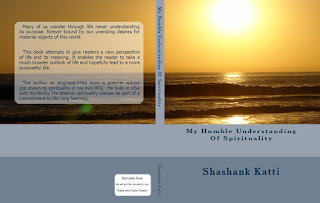

My Humble Understanding Of Spirituality


2. Attain Infinite Bliss

Attain Infinite Bliss - A Spiritual Guide


3. The Spirit Of Spirituality

The Spirit Of Spirituality


The Holy Bhagwad Gita - My Journey

Introduction Today, on the auspicious occasion of Gita Jayanti, I am humbly penning down my journey with the Gita.  The celebration of holy ...