When I ask anyone, what do you want in life, the answer is happiness. When I ask, happiness for how long, the answer is infinite happiness for ever. What is this state of infinite happiness? When we try to define happiness, one way could be a state where the mind is absolutely peaceful without any worries for an extended period of time. During our waking state, we enjoy the world, but at the same time are worried over something or other. Even as I enjoy the lovely Switzerland, there is a worry in my mind about the work I have to do when I get back. How about in my dream state? Sure, I am happy when I dream of dating the lovely Miss Universe. But how long is the happiness? As soon as her well built 220 lb boyfriend comes, my joy is gone! Now, let us look at deep sleep. Do I care what happens when I am in deep sleep? Someone may call me a donkey and I wont even know. Do I have worries of work? Absolutely not! So, here is a state where I am peaceful and without any worries. What if the same state of peace and lack of worries exists in waking state? Would that not be bliss?
All of us who have been students of spirituality are aware that this state of bliss is not somewhere far off. We ourselves are that Infinite state of happiness referred to as Brahman. If we are Brahman or that infinite happiness, why do we experience worries or distress? It is the innate Ignorance that is a characteristic of Brahman that creates the illusion of being separate from Brahman and creates all these worries and distress. Now, how can we remove this ignorance? Can we go to the market and buy some ignoricide to kill ignorance? Obviously not!. The only way to remove ignorance is by using our intellect. I can almost sense most people telling themselves, this is something we have and patting their back! Well, intellect is not same as intelligence acquired by reading a book or going to college. Intellect is that ability to discriminate between what is real which is the Brahman or state of bliss and the unreal world full of illusory happiness and worries. This sounds rather woolly. Let me give an illustration.
A man parachuted from an airplane and landed in a dense forest. As he tried to figure out the terrain, wild animals started chasing him. He started running fast and to his dismay saw a witch with wide open mouth waiting for him. Dismayed at this, he ran in another direction, stepped over some leaves which unfortunately were covering a pit and fell down. head downwards and legs up. As he was falling, his legs got entangled in some creepers and he did not fall. As his eyes adjusted to the pit, he looked down and saw a huge cobra at the bottom of the pit. As he looked up, he saw two rats gnawing away at the creepers holding his legs and preventing his fall to the cobra. As he was falling, he had disturbed a beehive and now the bees were stinging his body. However, there was a smile on the man's face. From the beehive, honey was dripping and falling on his lips. As he savored the sweetness of the honey, he was smiling.
You may wonder at the absolute foolishness of the man. But let us ask ourselves. Are we not like that man? We get parachuted into the jungle of life when we are born. As we try to make our way in this world, we are pursued by various diseases. As we continue in life, the evil witch of old age is waiting for us. The cobra of death is waiting for us and we are held on to life. The 2 rats of day and night rapidly eat into our lives and with each passing day, we are nearer to death. We are stung every moment of our lives by desires, worries, failures etc. But we forget all this and smilingly enjoy that honey of some happiness. Is this not absolute lack of intellect?
In most of our cases, unfortunately the intellect is clouded which is sad because that is the only instrument we have in our search for bliss. It is like being given a knife to cut a fruit, but unfortunately the knife has lost all its sharpness. What is it that clouds our intellect and makes it practically useless? It is the various desires that we have that clouds the intellect. The degree of masking of the intellect depends on the level or type of desires.
The following are the broad categories of desires and related masking of the intellect:
1. Tamasic desires: These are the hardest set of desires which are difficult to give up, almost impossible. These consist of addictions like drinking, gambling to name a few. For those inflicted with tamasic desires, the search for infinite bliss through the intellect is almost impossible. Their belief is that their addiction itself is their source of bliss. It is not just a belief, but a firm conviction that they are right in pursuing their desires to get happiness. Several lifetimes may have to be spent before these desires are exhausted and the individual even has a chance to realize that an instrument called the intellect exists and it can be used to pursue true bliss.
2. Rajasic desires : These are also intense desires, but not an addiction like in the earlier case. There is an intense desire to acquire wealth, power. For individuals with these intense desires, there is a glimmer of hope. It is like seeing smoke. You know fire is somewhere around and once the smoke settles, one can see the fire. Similarly in these individuals, with the right type of practice, the intellect can be awakened and sharpened to search for the infinite bliss.
3. Satvic desires : These are the desires to serve humanity, do good etc. For such individuals, the intellect is almost available to pursue the infinite bliss. It is like dust covering a mirror. It is easy to wipe the dust off the mirror and be able to see oneself in the mirror. Similarly satvic desires clouding the intellect can be wiped out relatively easily and enable the intellect to pursue the shining Self.
In conclusion, all of us are basically immortal and blissful. It is only the intellect that has the capability to pursue the path to realize this immense bliss. The clouding of the intellect can be removed through sustained practice. The paths are many to cleanse the intellect. One can pursue the path of selfless action also called as Karma yoga or follow the path of absolute devotion with an attitude of gratitude, called as Bhakti yoga or pursue the path of understanding the difference between the real and unreal through the path of Jnana yoga. There is no single guaranteed path for success. Each individual has to find a correct mix of the above three in their individual exercise of cleansing the intellect and acquiring the state of infinite bliss.
As readers may be aware, 3 of my books on spirituality are available on Amazon.com.
I invite readers of my blog to try any of the books and give me feedback so that I can make changes in the next edition.
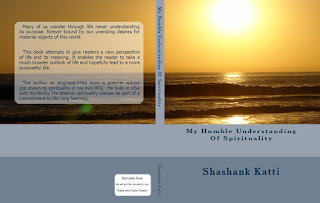
1. My Humble Understanding Of Spirituality
My Humble Understanding Of Spirituality
2. Attain Infinite Bliss
Attain Infinite Bliss - A Spiritual Guide

3. The Spirit Of Spirituality
The Spirit Of Spirituality

As readers may be aware, 3 of my books on spirituality are available on Amazon.com.
I invite readers of my blog to try any of the books and give me feedback so that I can make changes in the next edition.
1. My Humble Understanding Of Spirituality
My Humble Understanding Of Spirituality

2. Attain Infinite Bliss
Attain Infinite Bliss - A Spiritual Guide

3. The Spirit Of Spirituality
The Spirit Of Spirituality


