Showing posts with label bliss. Show all posts

Sunday, April 28, 2019

Niyamas - Are we really clean?

So far, in our discussion of the Astanga Sadhana, I have focused on the "Yamas". To recapitulate,Yama, deals with one's ethical standards and sense of integrity, focusing on our behavior and how we conduct ourselves in life. We talked about the following items:

  • Truthfulness
  • Non-Violence
  • Brahmacharya
  • Non-stealing
  • Non-possessiveness

Whereas the yamas present guidelines for how we should treat others, the niyamas tell us how to treat ourselves, moving us ever so slightly deeper along the path towards enlightenment. I will start my discussion of the second limb which is Niyama. Niyama, the second limb, has to do with self-discipline and spiritual observances. 

Niyama consists of the following items:

  • Shaucha: Cleanliness/Purity
  • Santosha: Contentment
  • Tapas: Discipline
  • Svadhyaya: Study of the self
  • Ishvara Pranidhana: Devotion to God

Today I will discuss the first one, Shaucha or cleanliness. When I say cleanliness, I can almost hear everybody saying, not an issue at all, we are all clean. Please follow my flow of thoughts and make your own judgement.

I would like to look at cleanliness from 3 perspectives, that of the gross body, second the subtle body and finally the causal body. When we talk of gross body and its cleanliness, I mean the physical aspect of cleanliness. Here again, there are three layers of cleanliness. The first layer is personal cleanliness.  Most of my readers i am sure maintain personal cleanliness. The next layer is cleanliness of surroundings, in my room, in my closet, my house, my office desk etc. I am sure many of us maintaining personal cleanliness show some slack when it comes to cleanliness of the surroundings. The next layer of gross body cleanliness is the environmental cleanliness. Are we polluting the environment ? Are we keeping picnic spots clean? Are we cleaning up our beer bottles from the beach? I am pretty sure at this layer, many of us tend to further slack off in cleanliness. Let us take a wild guess. If we randomly select hundred people and rate them on the three aspects of gross body cleanliness, what percentage would pass all three levels? I bet it will not be more than fifty percent.

The next layer of cleanliness, that of the subtle body includes cleanliness of the mind and the intellect. What is the dirt in the mind? Obviously, jealousy, anger, greed, hatred are the components of dirt in the mind. The intellect has its own dirt consisting of a sense of superiority by color, country, position etc; Dirt consisting of over blown ego of one's own importance etc. As readers are aware, this dirt is more subtle, more difficult to remove and actually more harmful than physical dirt in the pursuit of spiritual growth.So assuming we continue the above exercise, of the fifty who maybe physically clean, not more than twenty may be clean at the subtle body level. So, almost eighty percent of our sample is eliminated from the path of cleanliness which is one of the requirements of Astanga sadhana. 

Coming to the third layer, that of the causal body. This has vasanas or unfulfilled desires from several births as the dirt to be cleaned. Readers of my blogs are aware that the only reason for our taking births and deaths in a never ending cycle is because of our vasanas. Whereas cleaning the earlier two - gross body and subtle body were relatively easier, how do we clean the causal body? For one thing, we do not even know what all we have accumulated in our causal body. The only way we can remove the "dirt" in our causal body is by exhausting the dirt and by not adding additional dirt. Let me give a simple illustration. Assume we have fifty units of vasanas or desires in my causal body and in each birth , ten desires are fulfilled. So, I need a minimum of five births to exhaust and clean out my vasanas. But wait a minute, it is not so simple. In each birth that I take, most of us typically add new desires and when they are not fulfilled, they go back to the causal body and keep on putting us on a cycle of birth and death. So, the key step in cleaning the causal body is to not add new desires. Of course, this is easier said than done. However the first step is knowing the impact of desires and once we know it, making a conscious effort to refrain from new desires. This will hopefully reduce the causal body dirt to nil over a period of time. 

What do we get when all the three layers or bodies are cleaned? Beyond the three bodies is the Supreme Soul which is timeless, the very embodiment of Awareness, Truth and in essence the same as the Universal Brahman. If we plot the cleanliness on the X axis, starting with the gross body cleanliness, followed by subtle body and finally the causal body, and level of spiritual growth on the Y axis, I suspect we will get a hyperbolic curves. As we improve in cleanliness at the gross body level, there is an improvement in spiritual growth level, but at a very low rate. As we improve cleanliness at the subtle body layer, the spiritual growth shows an increased rate of growth and finally as we progress over multiple births on the cleanliness of the causal layer, the spiritual growth shows a sharp uptrend and we are finally on the cusp of achieving Divinity. When that final vasana is exhausted, we merge with the Supreme and then it is only Bliss.

Let us take the step to understand the dimensions of cleanliness and walk towards achieving our spiritual growth.

----------------------------------------------

Please buy and read any of these books:


Sunday, March 31, 2019

A Deadly Disease Lurking in most of us....

Today, as i continue with my discussion of Astanga Sadhana, I will introduce my readers to a deadly disease lurking in many of us. I rightly expect all of you to stand up and say, it is impossible, we are perfectly healthy. Well, please allow me to complete and then you can decide for yourself whether you have the disease or not. 

Let me start with a story since all of us love stories. There was once a pious man who lived on a hill focusing his life on spiritual activities. He used to subsist on just a pair of bananas left by some villagers nearby. Knowing that there would be bananas outside his house, a naughty monkey used to wait for the man to go into his meditation and run away with the banana. Owing to the noise created by the monkey, the man used to get up and try to chase the monkey, without any success. This went on for quite sometime and the man got fed up. He hatched a plan to teach the monkey a lesson. One day, he got a narrow mouthed vessel and kept the banana inside it and sat for meditation. As usual, the naughty monkey came and saw the banana in the vessel. It put its hand inside the vessel and caught hold of the banana and tried to take out its hand. However the mouth of the vessel was not large enough to permit the fist of the monkey with the banana to come out. The monkey kept on tugging at his hand, without leaving the banana. It tried to run. But it could not move quickly enough to avoid being caught. The man came from behind and caught the monkey and put it in a cage for life and the monkey lost its freedom forever. 

Well, think of the above. The monkey could have let go of the banana and run away. But it held on to the banana and was trapped. This is exactly the disease I am talking about afflicting many of us. I would like to christen it as " holdingonitis" since we also hold on to things without realizing the impact. Whereas, the monkey held on to a physical object, we as humans hold on to physical objects, mental objects, intellectual objects etc. The other day, I was trying to clear off our garage since it was filled with stuff. As I went through the items, I did not feel like throwing off my first marks card, my first coat, my first cricket bat etc. As i kept things aside that I did not want to throw, I realized I had ended up holding on to almost everything I had accumulated over several years. What greater example of "holdingonitis" for physical objects? 

Most of us also accumulate memories and emotions. We remember our first love, our first kiss and are happy with the memory and the emotion it brings. At the same time, we hold on to memories of grief at the death of a pet, hurtfulness when we were let down by someone and experience sadness. So, we end up with another case of "holdingonitis" where we hold on to emotions.

Next comes our tendencies to hold on to anything that is a ego booster or anything that is conceptual. We remember the title we won several years ago and gave us an ego boost. I know of a friend who won a prize in a general knowledge contest when we were in college and he makes it a point to remind everyone of it through social media posts every year ! Again a case of "holdingonitis" at an intellectual level where we hold on to past successes, glories, trophies, etc. 

Now that I have hopefully established the case that many of suffer from holdonitis, what is the consequence? Just like the monkey, which held on to the banana and lost its freedom, we are losing our freedom. Freedom what what, one may ask? As I have covered earlier, each one of is Infinite and Self Fulfilled. We are the very embodiment of happiness. But, due to an illusion of Maya at the Macro level and Ignorance of reality at the individual level, we look outside for happiness and hold on to objects assuming they give us happiness. The more we hold on to objects, the more we are bound to the Ego. As the Ego, strengthens, it weakens the connection with the Supreme and we are bound to the phenomenon of life and death, happiness and sadness forever. The only way to get rid of this bondage is by letting go.

I will end this discussion with another story I had told earlier. The Gods, Demons and Humans went to the Creator and asked him how they can be free and achieve bliss. To each of them, the creator just said, "Da". Since the Gods were enjoying excess luxuries, HE said they have to exercise DAma, which in Sanskrit means Restraint. Since the Demons were wicked and violent, HE said they should practice DAya, which in Sanskrit means kindness. Finally to the humans, HE said, we have to practice DAna, which means the act of charity or giving up, which is the antidote for "holdingonitis". 

To summarize, 

a. As part of Astanga Sadhana, Aparigraha is the fifth of the five yamas. 
b. Aparigraha (Sanskrit: अपरिग्रह) is the virtue of non-possessiveness, non-grasping or non-greediness.
c. "Holdinonitis" can be at physical, emotional or intellectual level.
d. The cause of "Holdinonitis" is Ignorance of the Reality.
e. The Outcome of the disease is loss of freedom.
f. The only cure for the disease is to let go.


Sunday, October 15, 2017

The 8 Step Path To Eternal Happiness - Ashtanga Yoga

Let me start this post with defining the purpose of human life. Is it just to acquire wealth, procreate, gain position, own big houses, cars, yachts etc ? One may say yes to all of above. But if we take a step  further and ask ourselves why we need all above. The answer would be , I need them because they make me happy. If we go further, do we need happiness for one hour, day, week etc, the obvious answer is we need eternal happiness. For most of my readers, the source of eternal happiness is known to be internal since we are the very embodiment of Peace and Happiness. However, by our wrong identification with our body, mind and intellect, the Divine Soul within which is pure and forever happy associates itself with feelings of sadness, pain etc and appears to be seemingly sad. So, the route to eternal bliss is not some far fetched road, but a road within our own hearts to discover our true self.  All this sounds good in an intellectual discussion, but is of no practical use to a seeker of the Infinite happiness. 

I can tell a budding boy the greatness of being a top seed tennis player and show him all the dreams. But that is just a pie in the sky. If I am serious about guiding him, I should show him the path to become a top seed player. I have to tell the boy about nutrition, about the type of bats, the techniques to play, the type of mental determination needed, the type of exercise needed etc. I also have to tell him how to progress from junior league to state league  to national to international league. 

In exactly, the same way, a seeker of Infinite Bliss needs instructions on how to prepare for the journey and how to progress on the journey. Many spiritual leaders have suggested their own paths for their followers. One such path which is very methodical and logical is Patanjali's Ashtanga Yoga. Patanjali, the great ancient exponent of Raja Yoga, wrote that the path to enlightenment embraces eight stages. This eight-limbed approach, known as Ashtanga Yoga is not to be mistaken as a step-by-step approach but a multidimensional approach in which all eight limbs are practiced simultaneously. 

The 8 fold path consist of the following:


  1. Yama
  2. Niyama
  3. Asana
  4. Pranayama
  5. Pratyahara
  6. Dharana
  7. Dhyana
  8. Samadhi

The 8 fold path is actually broadly categorized under two major headings:

  • Refining our personalities, gaining mastery over the body, and developing an energetic awareness of ourselves
    • The first 4 stages fall under this category
  • Controlling the senses, the mind, and attaining a higher state of consciousness.
    • The last 4 stages fall under this category

In this article, I am covering what each of the 8 stages mean. 


  1. Yama, deals with one's ethical standards and sense of integrity, focusing on our behavior and how we conduct ourselves in life. 
  2. Niyama, the second limb, has to do with self-discipline and spiritual observances. 
  3. Asanas, the postures practiced in yoga, comprise the third limb. 
  4. Pranayama consists of techniques designed to gain mastery over the respiratory process while recognizing the connection between the breath, the mind, and the emotions
  5. Pratyahara the fifth limb, means withdrawal or sensory transcendence. It is during this stage that we make the conscious effort to draw our awareness away from the external world and outside stimuli.
  6. Dharana, or concentration is the process to slow down the thinking process by concentrating on a single mental object: a specific energetic center in the body, an image of a deity, or the silent repetition of a sound.
  7. Meditation or contemplation is the stage where the mind has been quieted, and in the stillness it produces few or no thoughts at all.
  8. Samadhi, is a state of ecstasy when the practitioner has reached his ultimate goal and realized ultimate bliss.  
 In subsequent posts, I will go deeper into them.


------------------------------------------------------------------------------------------


Please buy and read any of these books which are available on Amazon.com.


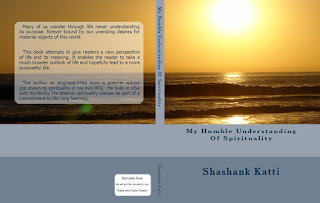
My Humble Understanding Of Spirituality


Saturday, February 15, 2014

Newest book on Spirituality

Thanks to the continuing support of all my readers, I have published the next edition of a book on spirituality. This book is structured differently from my earlier books and has illustrations to help understand some of the concepts.

It is titled, "The Spirit Of Spirituality"

It is available at the following locations:


I look forward to the continued support of all my readers.

Best wishes to all who are on this spiritual journey.

Wednesday, December 18, 2013

The Life Principle

This is one of the articles in a book I have written on spirituality. The book is available on Amazon.com.


The Spirit Of Spirituality


----------------------------------------------------------------------


The most important concept in understanding Indian spiritual though is the “life principle”. Many of the concepts of spirituality including reincarnation and karma become easily understood if one understands the “life” principle. But I have seen that it is very difficult to visualize and conceptualize. I will try to make this concept as easy to understand as my limited knowledge allows.

Let us start off with what is life? I am writing this article which implies I am alive and there is “life” in me. You are reading this article which means you are alive and “life” is in you. As you are reading this article, you look out and see your pet dog barking. The very fact that is barking means it is alive and has “life” in it. You see the dog is trying to chase a butterfly, which by the very fact that it is flying, implies it has “life”. The butterfly is landing on a flower which has just blossomed implying that the tree has a “life”. Now, is the life in me different from the life in a dog, in a butterfly or in a tree? It is obvious if we think a little bit that the “life” principle is the same in everything. The way life expresses is different in different forms. Life expresses in me through the act of writing, in you through the act of reading, in the dog in the act of running etc.

Now that we agree that the “life” principle is same, is there a limit to the “life” principle? Is it likely that one fine day, no new life of any form will arise? The very thought itself appears ludicrous. So, the life principle is infinite and as can be seen can take a variety of forms in expressing itself. Just as gold expresses itself through a variety of jewelry, just as clay expresses itself as a variety of pots, life expresses itself in a variety of forms. What happens when a jewel is melted? It returns back to its original condition which is pure gold. What happens when a mud pot is broken and crushed? It returns back to the original clay state. Let us think again from a different perspective. When gold is turned into a jewel, did anything happen to the gold itself? Absolutely nothing!  The gold was gold and continues to be gold, but now called as a jewel. Clay was clay and was given a new form called a pot. So the base material never changes, only the form changes. In the same way, when a life form is broken which implies death for a form, what happens? As far as the life principle itself is concerned, nothing changed. It was life only and it continues to be life.

The only reality then is the “life” principle. Anything else is just a form and associated name for the same life principle. If life is the same, then why are there so many forms of life? Well, if gold is the only reality, why are there different forms of jewels? It is the desire to meet different needs that creates the need for gold to be transformed into different forms and names. Similarly for each of us, it is inherent desires that propel life to take a form and name to fulfill our desires. So long as there is a desire for expression, life takes that form and expresses itself.

Let us now try and distinguish between life’s expressions in different classes of forms. We will take 3 broad categories: Plants, animals and humans. Animals here include birds, insects etc. A plant has life and does physical activity which proves it is living. It has its own way of procreation and reproduction. It has a limited amount of emotions as proven by various experiments. From what we know currently, the plant kingdom has very little intellect. The animal kingdom has significant physical activity, more emotions than a plant, but less than a human and more rudimentary intellect than a plant, but nothing compared to a human. The human has the most physical activity, well developed emotional capability and the intellect that differentiates humans from other living beings.

Plants and animals are “programmed” as though in their activities in life. They are born and at a particular age, they learn to fly, hunt etc. as their life form permits and then they die. They cannot take on a higher level activity than what has been programmed. A lion cub will grow up to be a ferocious lion only. It cannot by itself become a grass eating animal. A plan by itself will grow, have flowers, give fruits etc. It cannot decide to start moving around. Again, it is only the human form with the ability of the intellect to decide what they want. A human life is not programmed like animals or plants. It has the ability to think and decide what to do and what not to do.

Let us now turn to the causal effect of the various forms of “life”. The cause for taking a particular form of life in a particular environment is due to the impact of the doctrine of karma. The doctrine unequivocally states that you become what you desire or in effect, you reap what you sow. If I have very strong binding desires to taste flesh, I will be born as a carnivore. If I have a desire to be meek always, I will take the form of a cow. In each of these births, life is programmed to do just what is needed to fulfill the desire. It takes a lot of past karma to get the birth in human form. Even in human form, I may be born a leper or to a crook or in a rich family or a pious family, all because of the impact of karma. So, whatever situation I find myself in as a “life” form is due to the impact of my past karma. But what I do now in the circumstance is up to me and that is where the intellect plays a role.
Now, a question arises, if life is universal, infinite and the only reality, why are there a multitude of object filled world with variegated forms and names? Let me ask another question. When I am in a dream and am being attacked by a lion, why do I in real life break into a sweat and wake up shouting? Even though I am asleep in my own bed, why does an illusory dream cause real reaction in me? The answer is it is just the nature of the mind to create its own illusion and be afraid of its own created illusion or to create its own happy situation and revel in its own happy illusion. So also, life through a mysterious power of its own or characteristics of its own creates an illusion of multitude and each unit of that multitude assumes it is separate. It is like me entering into a room filled with thousands of reflective mirrors of every kind producing a fat me, a thin me, an ugly me  etc and each of those reflected people assuming they are separate from one another and from me who is the reality.

This apparent separation of the single unified life into several individual components causes this illusory world of separate life forms. It is on us as human beings with a high level of intellect to be able to realize this unified life principle and move on to a blissful existence.

As readers may be aware, 3 of my books on spirituality are available on Amazon.com.

I invite readers of my blog to try any of the books and give me feedback so that I can make changes in the next edition.


1. My Humble Understanding  Of Spirituality


My Humble Understanding Of Spirituality


2. Attain Infinite Bliss

Attain Infinite Bliss - A Spiritual Guide


3. The Spirit Of Spirituality

The Spirit Of Spirituality


The Holy Bhagwad Gita - My Journey

Introduction Today, on the auspicious occasion of Gita Jayanti, I am humbly penning down my journey with the Gita.  The celebration of holy ...